When it comes to Chinese language, nosotros don't demand to quote numbers and statistics to convince someone that information technology'southward one of the most widely used languages in the globe. Everyone knows that. It's a beautiful and fascinating language, and it looks and so different than almost western languages that we're used to.
How many kinds of Chinese are in that location?
As nosotros know, Chinese can be written with 2 dissimilar sets of characters — Traditional and Simplified. Both have character shapes that are roughly square, and each character has a monospaced foursquare width, which forms clean grids no matter the management the text is typed in.
Simplified Chinese is more often than not used in Mainland Communist china, and it's been the official writing system there since 1954, while Traditional Chinese was used prior to 1954. Traditional Chinese is still used widely in Chinatowns exterior of China, likewise as in Hong-Kong, Taiwan and Macau, where it's the official written language. In Mainland Cathay, it'southward used only in extremely formal cases. You can also find Traditional Chinese in other languages that have developed with influence from aboriginal Chinese.
Writing Chinese language
Historically, Chinese was set vertically and was being read from top to bottom and from right to left. Nevertheless, in the 50s — aslope the introduction of Simplified Chinese — it became standard to write in the Western style, from left to correct and from acme to bottom.
Nowadays, Chinese text is generally read from left to correct, the same as English. Considering of the square monospaced nature of the characters, it works every bit well both horizontally and vertically. This ways that in artistic contexts, where blocks of texts are relatively short (like book covers, logos and signage), information technology'due south ok to get artistic when it comes to how you layout characters without losing too much readability.
Some other significant characteristic of Chinese typography is the enormous multifariousness of characters that are available. Without any exaggeration, there are literally thousands of them! The smallest standard Chinese font contains 6763 characters. A typical Chinese font file is unremarkably at least 5MB in size and some of them can exist over 20MB, which is problematic if you need it loaded on a website. That's the reason information technology takes so much fourth dimension and effort to create a Chinese font, and it'south also why Chinese fonts rarely take a variety of weights — unlike their European counterparts, which often have as many as 5 different weights.
Chinese fonts
The two basic groups of Chinese fonts are songti (宋体), which you could think near every bit the Chinese serif, and heiti (黑体) — the Chinese version of sans serif, respectively. Additionally, there are decorative brush script fonts called kaiti (楷体).
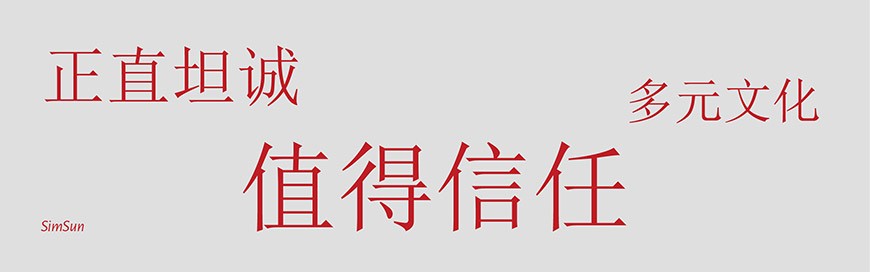
Songti (宋体)
If one type of font had to be chosen to represent Chinese typography, information technology would be the songti type. Early songti scripts were in use as far back every bit the Song Dynasty (960-1279 A.D.), when Chinese woodblock printing was in its golden age.
Due to the grain of the wood in the woodblocks, which ran horizontally, horizontal lines were like shooting fish in a barrel to produce and could be fabricated thinner. Vertical lines, which ran counter to the wood grain, were decumbent to breakage during carving, and thus had to be fabricated thicker. In addition, because the end points of the horizontal lines were easily worn away, flourishes were added to make them thicker, and then they'd last longer. This is how songti — the Chinese serif characterized by perfectly straight horizontal strokes, wider verticals, and classy just regimented flourishes — was born.
The font Zhongyi Songti (中易宋体), or commonly known in English equally SimSun, and its predecessor, New Songti (NSimsun – 新宋体) is the Times New Roman of Simplified Chinese, made popular due to its out-of-the-box inclusion in Windows XP. The Simsun love affair connected until very recently: information technology was nevertheless the default Simplified Chinese input font in Windows 7 systems. Enquire a Chinese web designer what makes an interface look "Chinese", and you'll often go a chuckle alongside the answer "Simsun, 12pt" — that should requite you an idea of how widely this font was used.
Examples for Songti fonts: SimSun, FZCuSong, NSimsun;
Heiti (黑体)
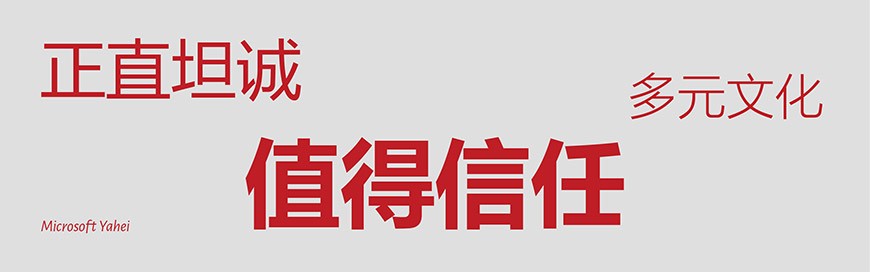
The other major nomenclature is the heiti, similar to "sans-serif". Heiti fonts are a relatively modern invention although they were seen emerging in commercial printing around the early 1900's.
SimHei was the standard sans-serif to SimSun's serif. Recently, Microsoft Yahei has started to replace SimHei as the preferred standard in spider web layouts, but there are still a couple of compatibility problems: MS YaHei was introduced in Windows Vista, just the number of machines withal running Windows XP in China — even in 2020 — would blow your mind. So while everyone's pretty tired of looking at SimHei, we haven't quite reached the betoken where people are willing to give information technology up completely just yet.
Yuanti (圆体) is typically considered a subclass of Heiti (sans-serif). It'south more of a search tag than a font type — the Chinese give-and-take yuan means "round", and that's exactly what these are: sans-serif fonts with soft curves at the corners. Yuanti is popular in modern corporate collateral and advertising materials. There are no web-standard fonts here either.
Examples for Heiti fonts: SimHei, Microsoft Yahei, Source Han Sans/Noto Sans, Yuehei, Shanghei;
Kaiti (楷体)
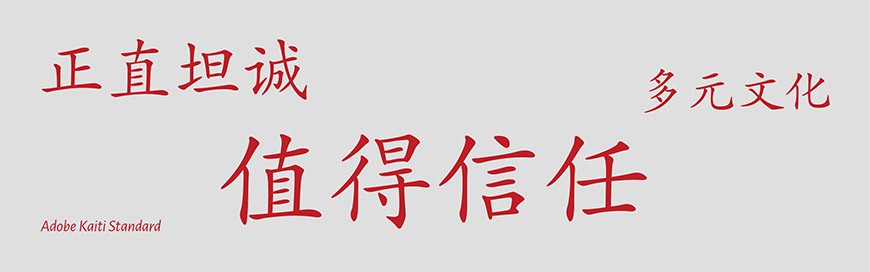
A kaiti font takes the shape of basic brush script lettering — or and then chosen "regular castor". A Kaiti font is still not a novelty font because it never gets overly flowery, yet it is synthetic within sure parameters while maintaining an upright structure.
Examples for Keiti fonts: Kaiti (or Biao Kaiti), FZKai, Adobe Kaiti Standard
Which fonts should you use?
We compiled a couple of convenient lists of fonts to cull from, according to your particular needs.
The most pop Chinese web-safe fonts:
-
- Heiti fonts:
- Hiragino Sans GB (冬青黑体简体中文)
- Microsoft Yahei (微软雅黑)
- Simhei (黑体)
- Songti fonts:
- Simsun (宋体)
(near screens are still non-Retina, and so information technology'due south much safer for designers to use Heiti fonts)
- Simsun (宋体)
- Heiti fonts:
Chinese fonts for gratuitous commercial use:
- 方正黑体 FZHei-B01S
- 方正书宋 FZShuSong-Z01S
- 方正仿宋 FZFangSong-Z02S
- 方正楷体 FZKai-Z03S
If you need a universal multi-purpose font (especially for multi-linguistic communication tasks):
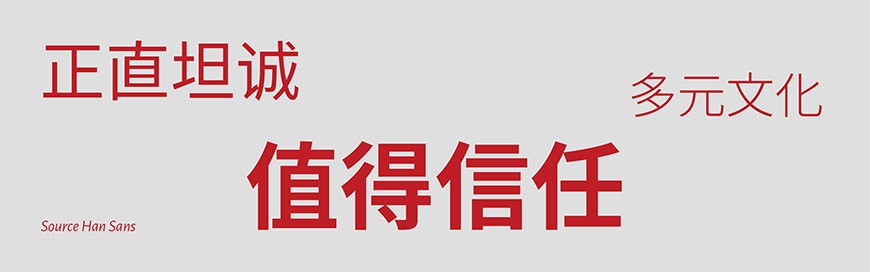
Source Han Sans
It's a sans-serif gothic typeface family unit, created by Adobe and Google. It was also released by Google (nether the Noto fonts project) as Noto Sans CJK. What makes this font so special is the fact that Source Hans Sans has 65,535 characters and 7 unlike weights (ExtraLight, Light, Normal, Regular, Medium, Assuming, and Heavy), and it provides a consequent and systematic style for Simplified Chinese, Traditional Chinese, Japanese and Korean. Things get fifty-fifty better— information technology'due south open-source!
A curious fact near this font: Despite having a "Regular" weight, information technology also has a "Normal" weight. The reason for that is the optical illusion that makes the font expect bolder when used on a dark background. So, the Regular is for light backgrounds and the Normal is for nighttime ones. Great, eh?
Mixing Chinese and Western texts
Designers sometimes face up the challenge of working with a mix of languages. That is especially common in places such as Hong Kong, where both Chinese and English are considered official languages.
Information technology'southward strongly recommended to add a space between Chinese and English, considering English naturally has a space between words, while Chinese does non. Chinese also has larger spaces between each characters, compared to English language letters. Ideally, in that location should be treated kerning between Chinese characters and English messages. Luckily, both Adobe InDesign and Microsoft Word offer options on how to do that.
The current trend
Equally we mentioned earlier, it takes a lot of effort to create a Chinese font. Fortunately, a lot of big Chinese brands — such equally Alibaba, Xiaomi, Tencent, Vivo, and Oppo — are developing their own fonts for marketing purposes. Hopefully, that volition lead to a greater variety of Chinese fonts in the future.
DOWNLOAD HERE
Posted by: hassanknom1994.blogspot.com


0 Comments